Exploring Korean Arts and Culture Through Feel the Korean Beat
Georgia Tech students explored South Korea's artistic traditions and contemporary culture this summer through Feel the Korean Beat, a five-week study abroad program led by the School of Modern Languages. The immersive experience highlights the Institute's commitment to global engagement through the arts and complements broader international collaborations, including Georgia Tech's partnership with the Korea Foundation on the Crossing Grounds: Art, Design, and Technology exhibition in Seoul.
This summer, a new group of Georgia Tech students embarked on Georgia Tech's annual five-week artistic and cultural journey, Feel the Korean Beat, a School of Modern Languages study abroad program in the Ivan Allen College of Liberal Arts. This international experience offered students an opportunity to explore South Korea's rich artistic traditions and contemporary culture while reflecting Georgia Tech's broader commitment to global engagement through the arts. That commitment is also reflected this summer through Georgia Tech’s partnership with the Korea Foundation on the international exhibition Crossing Grounds: Art, Design, and Technology in Seoul.
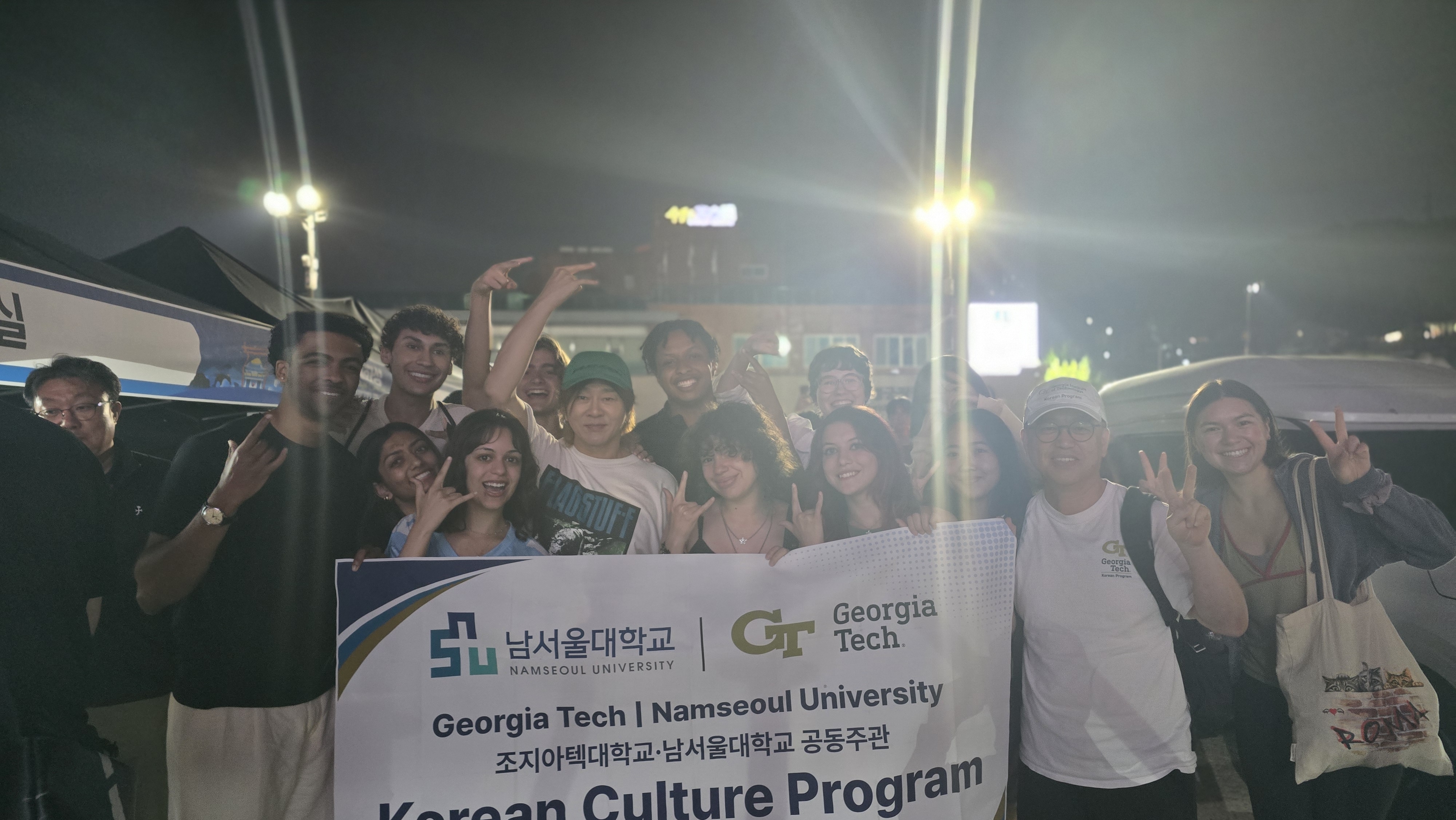
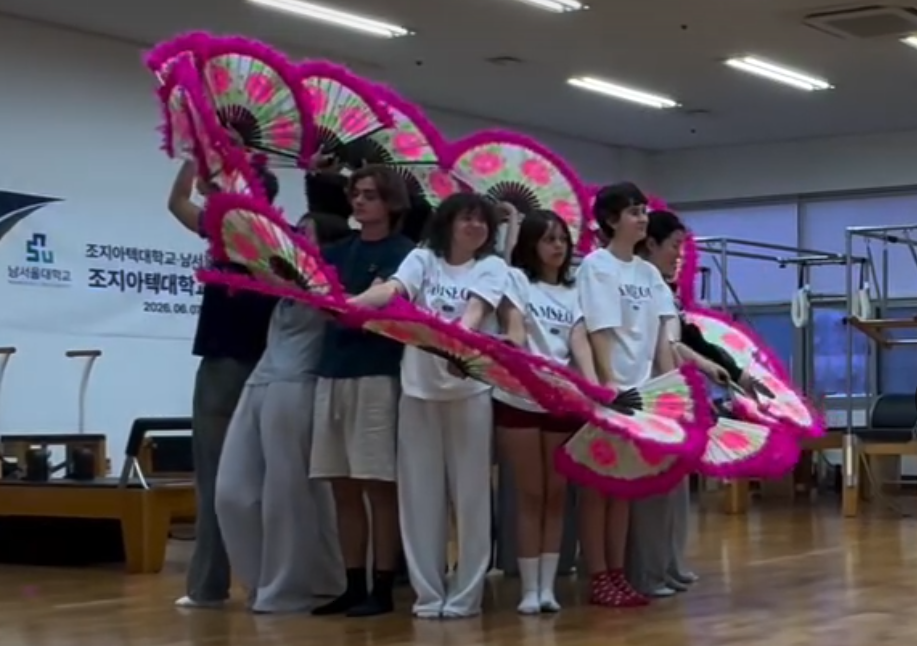
Led by Associate Professor of Korean Dr. Yongtaek Kim, Feel the Korean Beat introduces students to Korean arts and culture through vibrant, immersive activities. Students spend their summer exploring Korean music, dance, history, and daily life while engaging in cross-cultural studies, gaining a deeper understanding of the country's creative landscape. From a "K-pop pilgrimage" to outdoor adventures on Jeju Island and tours of South Korea's major media organizations, students experienced firsthand the value and appreciation for traditional arts through the ways they shape contemporary Korean culture.
This year’s participation fee was only $2,000—approximately one-third the cost of comparable study abroad programs—with scholarship opportunities made available through the program itself, the School of Modern Languages, and the Office of International Education (OIE). This year, one $1,000 scholarship was awarded to the child of a Korean adoptee, and three $500 scholarships were awarded to members of the Georgia Tech Samulnori Club (GTS)
The experience is designed for students with no prior proficiency in Korean, removing the language barrier as an obstacle to cultural immersion. Rising sophomore Natalie Ferry, who documented her journey on social media as part of a class assignment, felt that the English-medium programming helped deepen her comparative understanding of Eastern and Western art.
"Korean folk music really serves as a historical record,” explained Ferry. “Of course, we see that with Western music too, but the influence of Korean folk music is still being advanced to this day. BTS' 'Arirang' is a great example of this: how folk culture is honored in modern art as a way of reminding people, 'Remember this. These are our roots.'"
The cohort’s journey through Seoul, Cheonan, Daejeon, and Jeju Island concluded on Jindo Island, where students learned and performed Samulnori, a traditional Korean percussion art form, at the renowned Jindo National Gugak Center. One of Ferry's biggest takeaways from training in Samulnori was discovering how closely Korean folk music is connected to the country's geography:
"Samulnori was made to be done in the [rice paddy] fields,” she explained. “It's working music—it's loud, it's rambunctious; it's meant to be heard over long distances. It also varies across each region; the music is inspired by the landscape. In Seoul, for example, it's become more experimental, being near the capital, which differs from rural areas where the rhythms are smoother and more delicate." The program was partially supported through a partnership with Namseoul University in Cheonan, where students lived and studied during their second week abroad. While the campus experience felt familiar in many ways, it also allowed students to understand university life from another perspective.
Ferry said the similarities often stood out more than the differences. The hospitality she experienced from professors, she said, reminded her of the "Southern hospitality" she had grown accustomed to in the United States.
That hospitality extended beyond the classroom, which informed Ferry’s understanding of how the Georgia Tech name shows up outside of Atlanta.
"It was cool to learn how Georgia Tech is kind of a known entity in Korea,” she said. “But it makes sense. South Korea is heavily invested in AI in a way that mirrors Georgia Tech's investment. They both value being at the forefront of technological innovation, and almost every single person I met valued being on the cutting edge."
While the Feel the Korean Beat cohort did not directly overlap with the opening of Crossing Grounds: Art, Design, and Technology, both initiatives celebrate Georgia Tech's growing engagement with South Korea through arts and culture. The exhibition, co-curated by Assistant Professor Hyojin Kwon and Georgia Tech Arts strategist Birney Robert, with assistance from Santana Nash, brings together 16 projects by Georgia Tech artists that explore the intersections of art, design, and technology.
Together, these efforts demonstrate how arts-integrated experiences can strengthen international partnerships, broaden cultural understanding, and encourage students to engage in unfamiliar places with curiosity, creativity, and confidence.
Learn more about Feel the Korean Beat.