
Ellen Dunham-Jones: Designing What Comes Next
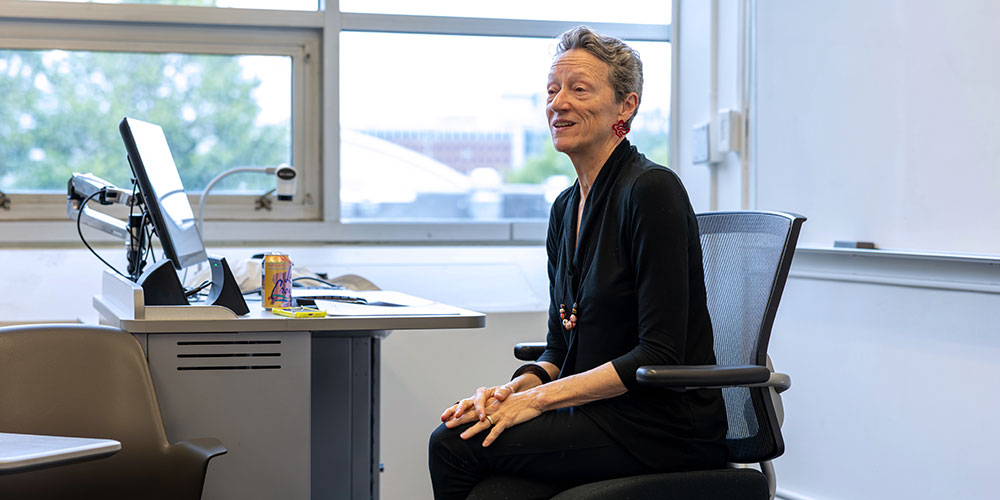
Ellen Dunham-Jones has spent a career asking a deceptively simple question: what do we do with the places we already have?
For decades, the answer has shaped how cities across the United States rethink growth, sustainability, and community. As a professor, author, and urbanist, Dunham-Jones built her work around a reality many cities are still catching up to: the future of urban design is not just about building new places, but transforming existing ones.
That question came full circle in Spring Semester 2026, with her final class at the Georgia Tech School of Architecture.
Ellen Dunham-Jones has spent a career asking a deceptively simple question: what do we do with the places we already have?
For decades, the answer has shaped how cities across the United States rethink growth, sustainability, and community. As a professor, author, and urbanist, Dunham-Jones built her work around a reality many cities are still catching up to: the future of urban design is not just about building new places, but transforming existing ones.
That question came full circle in Spring Semester 2026, with her final class at the Georgia Tech School of Architecture.
A Career Focused on Transformation
Dunham-Jones is widely recognized as a leading authority on suburban redevelopment. Her work has centered on what happens when aging infrastructure, from shopping malls to office parks, no longer serves the communities around them.
As co-author of Retrofitting Suburbia, she helped define a movement. The book documented how underperforming, car-dominated spaces could be reimagined into walkable, resilient, and socially connected environments. It went on to receive a PROSE Award and helped push suburban retrofits into mainstream planning conversations.
Over time, her research expanded into a growing database of more than 2,500 retrofit projects. These case studies explored how design can address public health, climate resilience, economic development, and equity, all through the lens of reuse rather than expansion.
Her work has been featured widely, from national media outlets to a TED talk viewed hundreds of thousands of times. She has served in leadership roles with the Congress for the New Urbanism and earned recognition as one of the most influential urbanists working today.
At Georgia Tech, she brought that perspective directly into the classroom.
Teaching Cities as SystemsDunham-Jones’ courses attracted students from across disciplines. Architecture, city planning, real estate, and public policy students all worked together to examine real-world challenges.
Her studios often partnered with communities, asking students to propose ambitious redevelopment strategies grounded in local needs. Her seminars pushed them to think critically about how cities evolve over time, and how design decisions ripple across systems.
That systems thinking has become increasingly important as new technologies begin to reshape urban life.
In her final class, the conversation turned to one of the biggest unknowns facing cities today: artificial intelligence.
Rather than a lecture, Dunham-Jones opened the floor.
Students debated how AI is already influencing design, from rendering tools to logistics optimization. Some saw it as a powerful assistant. Others questioned its limitations.
“AI is only as good as its user,” one student noted, pointing to the role of designers in guiding outcomes.
Dunham-Jones pushed the conversation further. She challenged students to look beyond aesthetics and ask whether AI-generated designs actually function in the real world.
“It’s very good at producing an attractive rendering,” she said. “But from an operations perspective, is it functional?” Her skepticism was not about rejecting technology. It was about understanding its limits.
Drawing from her own research, she pointed out that even simple historical queries can produce incorrect results, especially when AI prioritizes recent information over accurate context.
The discussion quickly expanded to cities. Students explored how AI could reshape mobility, particularly through autonomous vehicles. The potential benefits were clear. Increased efficiency, optimized traffic flows, and new forms of transit.
But the risks were just as significant.
Would autonomous systems reduce congestion or double it? Would they make cities more equitable or deepen existing divides? Could they lead to more walkable communities or accelerate suburban sprawl? Dunham-Jones framed the question in familiar terms.
Cities, she reminded them, have always been shaped by the technologies that move people. From animals to trains to cars, each shift has redefined urban form. AI may be the next shift, but its outcome is far from certain.
“Is it going to result in a more equitable, more sustainable, more delightful city,” she asked, “or something more congested, more car-oriented, less walkable?”
There was no consensus.
Some students imagined autonomous vehicles communicating with each other, reducing human error and improving efficiency. Others pointed to new challenges, from infrastructure costs to the possibility of increased privatization of public space.
The conversation reflected a core theme that has defined Dunham-Jones’ work. There are no purely technological solutions. Every innovation comes with trade-offs, and every design decision has consequences.
Throughout her career, Dunham-Jones has focused on helping communities adapt to change. Whether that change comes from economic shifts, environmental pressures, or new technologies, her approach remains consistent.
Start with what exists. Understand how systems work. Anticipate unintended consequences.
That mindset was evident in her final class. Rather than offering answers, she left students with questions. Who benefits from new technologies? Who is left out? How do we design cities that remain flexible as conditions change?
It is the same framework that has guided her research, her teaching, and her impact on the field. As she steps away from the classroom, those questions remain. They now belong to the students she taught and the cities they will help shape.
And if her career has shown anything, it is this: the future of cities is not predetermined. It is designed.


