
Georgia Tech Student Helps Push the Boundaries of Robotics and Creative Innovation
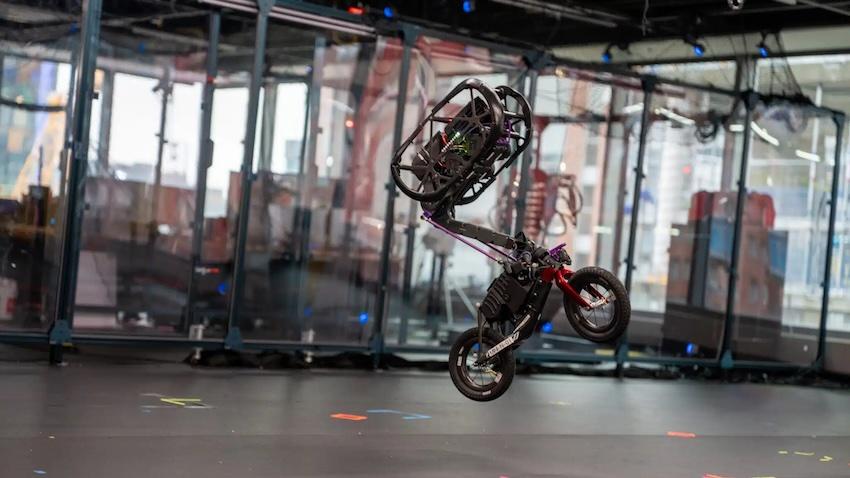
A Georgia Tech Ph.D. student helped develop a novel control system that enabled a bicycle robot to successfully perform and land the world's first unassisted front flip. The achievement highlights how creativity, experimentation, and technological innovation continue to shape the future of robotics.
Researchers at Georgia Tech are demonstrating how creativity and technology can come together to solve complex challenges.
Jeonghwan Kim, a Ph.D. student in the School of Interactive Computing, recently contributed to a breakthrough robotics project at the Robotics and AI Institute (RAI) in Cambridge, Massachusetts. During a two-semester internship, Kim helped develop a learning framework that enabled a bicycle robot to successfully perform and land an unassisted front flip, a first for this type of robotic system.
The project focused on an ultra-mobility vehicle, or UMV, an experimental robot designed to combine the agility of athletic movement with the versatility of two-wheeled transportation. Kim's work centered on developing a control policy that allowed the robot to learn from simulated demonstrations and refine its movements over time, ultimately improving its ability to land safely and maintain balance after completing an aerial maneuver.
Beyond the technical achievement, the project reflects the power of interdisciplinary thinking and creative problem-solving. By combining robotics, artificial intelligence, simulation, and human-centered design, researchers continue to explore new possibilities for how machines move, adapt, and interact with the world around them.
The accomplishment underscores Georgia Tech's commitment to innovation across disciplines and highlights the role that imagination and experimentation play in advancing emerging technologies.
Read the full story from the College of Computing.


