
Strange Intimacies: Where Art, Ecology, and Technology Meet Community
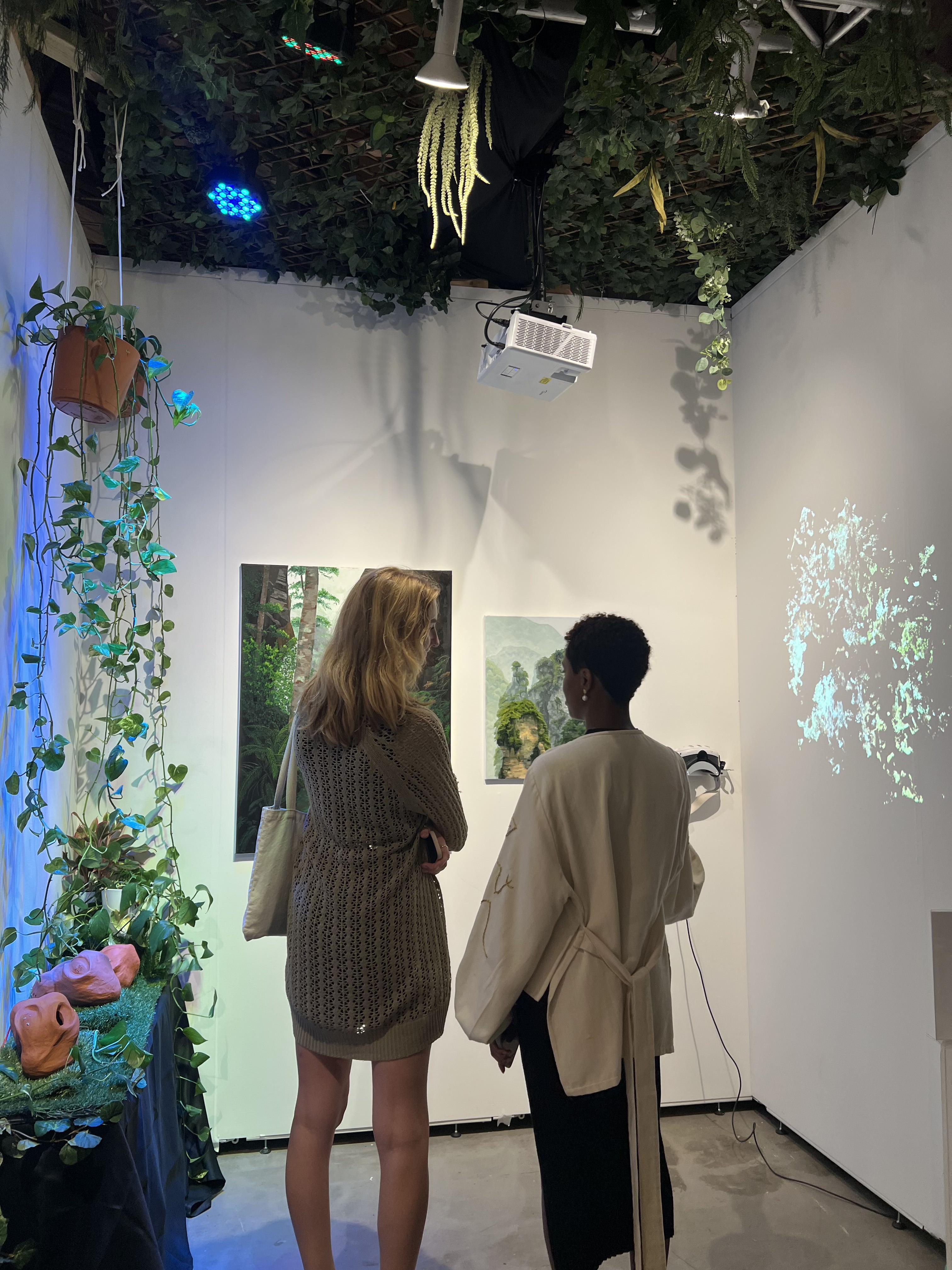
Georgia Tech Arts and Fulton County’s Public Art Futures Lab showcased interactive artwork exploring the intersection of art, technology, and ecology at the 2026 Atlanta Art Fair.
This year, Georgia Tech Arts and Fulton County’s Public Art Futures Lab (PAFL) collaborated on Strange Intimacies, an exhibition booth at the 2026 Atlanta Art Fair at Pullman Yards. According to AMP, the company that owns the Atlanta Art Fair, the fair welcomed more than 13,000 visitors and featured more than 80 regional and international galleries. The fair recorded 128 ticket downloads using Georgia Tech’s discount code.
The booth featured work from three projects developed among the Georgia Tech Arts community members: Professor Heidi Biggs (School of Literature, Media, and Communication), GT Arts Catalyst Grant recipient Belinda Person, and GT Arts Microgrant recipient Allie Teixeira Riggs (MS Digital Media ’25), and Atlanta community artist Shelly Boehm. In conversation with one another, their technology-driven pieces explored the relationships between human bodies and the natural world.
Person’s Biophilia, a 2025-26 Catalyst Grant project developed in collaboration with Krystian Ramlogan, uses interactive virtual reality paintings to explore the uncanny entanglement of the corporeal and ecological. Riggs and Boehm’s Lichen Meditations considers interconnectedness through an interactive, motion-based particle visualization. Biggs’ Sensing Stones invites communities to consider the relationships among heat, shade, and the often-invisible effects of climate change.
Riggs also served as the booth’s lead curator, building on Queer Data Ecologies, an exhibition they previously curated in collaboration with PAFL. The exhibition received a GT Arts Microgrant in spring 2026 and featured student work from across Georgia Tech’s campus. Their leadership on both Queer Data Ecologies and Strange Intimacies stemmed from a desire to “unite artists who work across themes of environmental precarity and embodied ways of knowing.”
“The theme for this booth focused on illuminating the inherent strangeness of our relationships with environments,” Riggs said. “We’re within the world—the environment— but we imagine ourselves as separate from it, or we insulate ourselves from it. This is a central paradox that shows up in all three of the works in the show.”
Birney Robert, curator and strategist for external engagement with GT Arts, worked with Kathleen Brown, PAFL’s arts education coordinator, to build on Riggs’ earlier exhibition at PAFL’s downtown Atlanta space and bring their curatorial work to the Atlanta Art Fair. With Riggs at the helm, Robert and Brown saw value in bringing art and technology together at one of the region’s largest creative gatherings.
“For [Biggs, Person, and Riggs],” Robert said, “the exhibition booth creates a public context in which research-driven, technology-enabled work can be experienced directly by audiences. For PAFL and Georgia Tech Arts, it demonstrates why collaborations between a research university and a community-based public arts organization matter: together, they can provide artists and researchers with spaces to test ideas, engage communities, and take their work beyond traditional institutional boundaries.”.
Robert also noted how the interactive nature of Strange Intimacies gave visitors a different way to encounter art at the fair and experience research outside an academic setting. The works invited audiences to consider the paradox of a “strange intimacy” by noticing the contrast between the technology in the booth and the natural world it represented.
“I loved how interested children were in interacting with Sensing Stones,” Riggs said, “or even how completely in awe one elderly man was at the VR experience of [Biophilia]. It was meaningful to see the capacity of interactive works to both draw folks in and influence perspectives, particularly around ecological interconnectedness, understanding, and responsibility.”
That capacity for impact shapes PAFL’s collaboration with Georgia Tech Arts, one of the lab’s Knowledge Partners. The exhibition showed student collaborators how questions that begin in a classroom or lab can spark meaningful conversations with metro Atlanta audiences.
“One thing we hear from Georgia Tech collaborators is how valuable it is to bring their work beyond the academic environment and engage with audiences of different ages, backgrounds, and levels of experience,” Brown said. “That kind of real-world interaction offers perspectives and feedback that can sometimes be hard to find inside a university setting, helping artists, researchers, and musicians better understand how their work resonates with the broader public…and creating opportunities for meaningful knowledge exchange in both directions.”
Georgia Tech community members can get involved with PAFL through free workshops, public programs, open calls, and its annual artist-in-residence program. The residency, sponsored by Downtown Atlanta Inc. and MARTA Artbound, launches in January. Learn more by following @FultonPublicArt on Instagram.
Georgia Tech students who would like to pursue community-driven creative projects can apply to the GT Arts Microgrant program through Nov. 20.


